Natives For Your Neighborhood is a labor of love and commitment. If you use this website, help us maintain and grow it with your tax-deductible donation.
Please scroll to the bottom for more images.
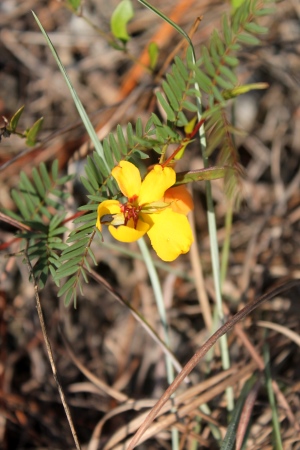
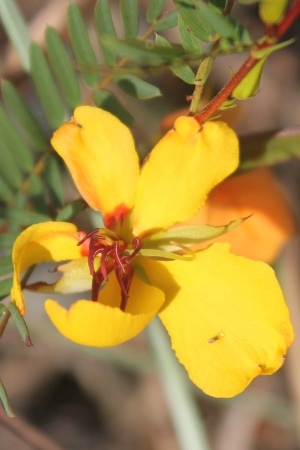
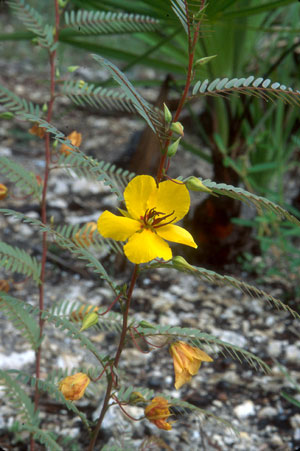
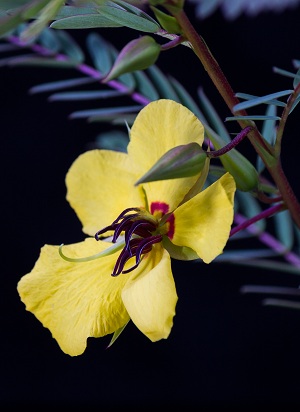
Deering partridge pea Chamaecrista deeringiana
Fabaceae
Copyright by: James Johnson, 2014 In habitat, Everglades National Park, Florida Expand
General Landscape Uses:
Primarily recommended for natural landscapes and habitat restorations. Also wildflower and butterfly gardens.
Ecological Restoration Notes: It can be used as one of many understory herbs in pine rocklands.
Availability:
Grown by enthusiasts.
Description: Medium perennial herbaceous wildflower.
Dimensions: Typically 1-3 feet in height. Sometimes as tall as broad, but often spreading.
Growth Rate: Moderate.
Range:
Southeastern United States south to the Monroe County Keys. Very rare in South Florida outside of Miami-Dade County. Perhaps never present or exirpated in Broward County. Presumed extirpated in the Monroe County Keys where collected once on Big Pine Keys in 1912.
Soils: Moist, well-drained limestone or sandy soils, without humus.
Nutritional Requirements: Low; it grows in nutrient poor soils.
Salt Water Tolerance: Low; does not tolerate long-term flooding by salt or brackish water.
Salt Wind Tolerance: Moderate; grows near salt water, but is protected from direct salt spray by other vegetation.
Drought Tolerance: High; does not require any supplemental water once established.
Light Requirements: Full sun.
Flower Color: Yellow petals; red anthers.
Flower Characteristics: Showy.
Flowering Season: All year.
Fruit: Inconspicuous pod (legume).
Wildlife and Ecology: Provides food for birds. Larval host plant for cloudless sulphur (Phoebis sennae) butterflies. Likely attracts bee pollinators.
Horticultural Notes: Can be grown from seed. Plant in a pot with 2" or more of potting soil and spinkle soil over seeds to just cover them. Place in full sun or light shade. Keep moist.
References: Miami-Dade County Landscape Manual (2005).
Comments: Distinguished from the annual partridge pea (C. fasciculata) by its red (vs. yellow) anthers.
Copyright by: James Johnson, 2014 In habitat, Everglades National Park, Florida Expand
Copyright by: George D. Gann, 2015 In habitat, Long Pine Key, Everglades National Park, Florida
Copyright by: George D. Gann, 2015 In habitat, Long Pine Key, Everglades National Park, Florida










 Map of select IRC data from peninsular Florida.
 Map of suggested ZIP codes from South Florida north to southern Brevard, Osceola, Polk, and Pasco counties.